Tuesday, 29 January 2019

3 women & Mr Baby

Anyone who travels to India simply has to get a Mr Baby.
He was our unruffled, courteous, careful and immaculately dressed driver and the only person on our eight-day tour in ‘God’s Own Country’ to be consistently punctual.
There is time, and then there is Indian Standard Time. All over the world Indians admit there is an unwritten code to never be on time and in Kerala, to never stick rigidly to any given plan. However this intrigue, this uncertainty, contributed towards making our tour in Kerala so fascinating.
Paddy fields
Whoever labelled Kerala ‘God’s Own Country’ (the Internet debate on that subject has narrowed it down to a creative director of a local advertising company) was spot on because the region really is rather like I imagined the Garden of Eden of biblical fame to be. Keralites, or Malayali people, can literally pick the fruits of the forests and survive if they have to. Bananas, paw paws (papayas), jackfruits, coconuts literally fall from the trees, while pineapples, strawberries, sugar cane, tapioca and a multitude of spices can be sourced around every corner.

Credit must go to our tour organisers Tern Trips, not your regular travel agents but rather off-beat travel-planners with second-to-none insider knowledge about their home state. They are off-the radar (an Internet search will reveal nothing). I found them via a personal recommendation.
Hubre in a tuk tuk 
As a first-timer to India I had a rough outline of the type of experience desired (not excessive driving, nature-based, budget but not too budget, etc) and Tern Trips planned the rest. It was not without hiccups of course, but we experienced a very varied taste of Kerala with a perfect concoction of activities, sights and destinations. 

Departure Dubai
So on 12 November Janee and I met Hubre (who flew in that day from South Africa) at Dubai International Airport’s gate to Cochin (now Kochi). Emirates delivered us to the modern, squeaky-clean Cochin International Airport on India’s south west coast 3½ hours later. This was the first of many surprises. Despite all the research I still imagined my arrival in India would be similar to the chaotic scenes in City of Joy, Lion, Best Exotic Marigold Hotel and Slumdog Millionaire.  
[Another preconceived idea quashed was that snakes would fall out of cupboards when you opened them; some snakes had indeed been displaced by the recent devastating floods and had found refuge in dark places in private homes. The only serpents I saw were plastic.]
Brunton Boatyard from the ferry

Mr Baby from Intersight Tours & Travels waited with a placard bearing my name and soon enough we were in a Toyota Innova Crysta bowling through the port city studded with colonial architecture - Portuguese palaces, Dutch mansions, British warehouses; past huge shipping structures via the Goshree Road to Vypin and on to the ferry to Fort Kochi.
Mr Baby (he had a much finer name of Abraham Ochelekal but the nickname is so much more memorable) bought Janee some herbal oil for her knee as she was limping. She twisted it while sitting cross-legged in an economy seat, not something I would ever attempt… 
On the 20 minute ferry journey we saw where the seawater from the Arabian Sea met the freshwater of the Vembanad Lake.

The Ambassador & I
The Ambassador
Thomas Tharian, deferential proprietor of homestay Fort Garden Residency, offered basic clean and comfy accommodation, drinking water and good advice about Cochin such as where to eat (another preconception was to contract a ghastly Delhi belly the moment we ate anything. Note: we didn't get sick once). Hotel Seagull's casual restaurant with its view over the harbour was such a place, presenting superb seafood and a memorable thick spicy vegetable soup.

Parked under a huge tree near our homestay was a white Ambassador, you know that one manufactured by Hindustan Motors. It was one of the world’s most iconic sedans that started production in Kolkata (formerly Calcutta) in the 1950s. I saw quite a few in Cochin and was tempted to ask their owners for a ride but never did.
Steam boilers
Willingdon
On the promenade by a litter-festooned beach there were two rather curious tourist attractions that had a connection to my sister in Willingdon, East Sussex. The plaque read: “Steam boilers of the cranes used in Cochin dry dock for 20 years from 1956. It used coke, coal, and firewood as fuels. Notable use of these cranes included attending annual repairs of dredger Lord Willingdon and Lady Willingdon”.
I discovered later that Lord Willingdon (once plain Mr Freeman-Thomas) was India’s 22nd Viceroy and Governor-General from 1931 to 1936; the large dredger named after him was built by a Scottish company; and his family once owned Ratton Manor and Estate in the Willingdon region near Eastbourne.
The Lady Willingdon was a small bucket dredger that helped in the building of the port. The real live Lady Willingdon was Marie Adelaide Freeman-Thomas (née Brassey).
Chinese fishing nets
Kingfisher time

Of less significance to me were the cantilevered Chinese fishing nets, a feature of Cochin that I had yearned to see. These nets supported on huge arced frames and operated by levers and counterweights were not as special as I had imagined. Perhaps it would have been better to have seen them in action at sunset but by then we were quaffing a few Kingfisher beers.
Chendamangalam Synagogue's ceiling
The synagogue
Next day Mr Baby propelled us to Kodungallur where we peeked at the Cheraman Juma Masjid (mosque), passed Paliyam Palace (closed for renovation) and stopped at the Muziris Heritage Project, although I am now doubting where we actually were as the Internet descriptions and photos of the place we went to aren't remotely similar. We saw some ruins, plastic sheeting, saw ant-lion craters in the dirt; spoke to a woman who told us about the legendary port of Muziris and the Portuguese in the late 1500s but there was nothing too inspiring to report here. 

Ant-lion homes
                                                          Chendamangalam Synagogue further on was more interesting particularly for Jewish Hubre. The synagogue has a brightly coloured chequered pattern with flowers in relief on its high ceiling. A spiral wooden staircase leads to a balconwith beautifully carved balusters and railings, and behind that is the women’s partition.
It was surprising to hear how few Jews are left in Cochin (26 at last count according to an article in Haaretz) since they arrived in the region around the 12th Century; most seemed to have headed off to Israel after 1948.

Cheeyappara Waterfalls 
By afternoon we were weaving towards Munnar in the Western Ghats some 1,600m upwards, winding through towns, rubber plantations, lush forests, past some chained up buffaloes (an abbatoir), elaborate houses belonging to Middle East-based Indians, shacks belonging to local Keralites, spice plantations and more. We stopped at Cheeyappara Waterfalls that flow down in seven tiers apparently. Most other tourists en route to Munnar stop here too.
The road twists and climbs, narrows alarmingly in some places “…where everything looks like an accident about to happen,” said Hubre. There were signs of the damage caused by the terrific floods that affected Kerala in August 2018; fallen trees and branches, churned up roads and gouged out hillslopes revealing raw earth.
Not too sure why Chandy’s Windy Woods was the hotel chosen for us (Chandy or chandi means ass i.e. bum in Malayalam) but who cares, it was magnificent and a destination in itself. Their chenda mellam welcoming committee of bare-chested drummers was Wow!  - incredibly loud and vibrant in the cool night air. This hotel was another magnificent surprise for we were expecting something far more modest. The higgledy-piggledy design of the hotel held, in a central atrium over two or three floor levels, an enormous artificial Banyan tree (ficus benghalensis) dripping with aerial roots and tendrils. Perhaps there are restrictions to growing a real one for it is a holy tree for many religions and also the National tree of India.

A view to wake up to 
Tea plantations
Dawn brought a spectacular view from our balcony – lush greenery, artistically contoured tea plantations, flowering plants, spread out below as we breathed in the fresh air and listened to gentle bird song as the hills slowly awakened. Perennially cool, Munnar was a favoured summer resort for one-time British government officials who also relished the serenity - acre upon acre of tea, coffee, cardamon, pepper, clove, cinnamon, vanilla, nutmeg and more.

CSI Christ Church, Munnar
Chandy’s breakfast was spectacular; from coconut curries to boiled eggs. After that we went to watch a hand-weaver create material on a loom, then in Munnar town visited CSI Christ Church (CSI abbreviation is Church of South India NOT Crime Scene Investigation) built in 1910 by the British. It has exquisite stained glass windows and on the walls are engraved brass plaques dedicated to tea planters. Pioneer planter Eric H Francis and his wife Marjorie Innes who did a lot of good works here, had a rather sad note at the end of their plaque: “….and Godfrey H Francis, Ph. their only son born Pullivasal in 1928, killed by lightning while climbing an English hill, 1960. I WILL LIFT UP MY EYES TO THE HILLS”.  I thought that particularly poignant.

Confusion reigned this day for between us 3, our travel planners and Mr Baby plans for the day were lost in translation. There was just an unfathomable disconnect, none of us were in synch! 
[Note to self: buy a map of Kerala before you leave home! Often we had no idea where or in what direction we were going, and we kinda felt we needed to know that. Mr Baby eventually found us a little store which had just the ticket.]                                                           
We drove past a huge billboard indicating UN World Toilet Day was imminent, in fact on 19th November. The day is marked to encourage all to take action to ensure that everyone has a safe toilet by 2030. It was an apt reminder to ask our travel planners how to politely ask Mr Baby to “stop the car I need a pee like NOW”. And it is easy enough – just hold up the pinky and wiggle it. A universal sign apparently.

After some time we finally met our travel gurus Srijith Sridharan, Aswathi Gopinath (Achu) and her cousin Appu (Rajasekhar Vishnu Das). They had driven by car from Cochin to meet us, which had taken longer than anticipated. Or had left late. Or hadn’t actually left from there but from another destination, we never really understood. But whatever, we were here together in the Western Ghats, a biodiversity hot-spot that contains loads of the country's plant and animal species. 
The scenery is something else. Trees heavy with blossom including spathodea, cassia and pointsettia, plus jacaranda trees, were all so familiar to me that it was like coming home to Africa. Angel’s trumpet (a bell-shaped flower), morning glory, orchid, fuschia, bougainvillea, rose and jasmine clung to the roadsides for dear life as we rumbled by. Dotted randomly among the tea plantations covering the hillslopes were silver birch trees, grown to protect the young tea plants as well as to absorb excess water.


About 15 kilometres from Munnar is the Eravikulam National Park of shola forests where prime attractions are the Nilgiri Tahr, an endangered species of mountain goat, and Neelakurunji (Strobilanthes kunthianus) a blue coloured shrub that blooms every 12 years - and 2018 was its year to bloom. We were lucky enough to find a few still visible on the plants.
The park was jam-packed with large buses, cars and locals. We all piled into the feeder bus that takes you up the mountain to a certain point from which there’s a comfortable walk to the top for the view of a mosaic of green hues from shrubs, stunted evergreen trees, moss and grassland. 
Half-way to the top were the country’s first automated e-toilets, a scheme from Eram Scientific of Thiruvananthapuram, a company that aims to solve the issue of India’s many unhygienic public loos. The occupant is guided by audio commands, it flushes automatically and the next user doesn’t get access until it is clean.

Tea museum
Tata Tea Museum
After a superb lunch at a hotel Issacs Residency back in Munnar, the six of us toured the Tata Tea Museum. The entrance walls studded with trophy animal heads seemed rather incongruous to me, and the selection of ‘vintage’ office equipment - much that I could well have had in my own house - showed just how old I am. The tea processing was interesting, explained by an enthusiastic guide.
       The onward journey to a remote village somewhere produced some stunning vistas of shiny-leaved tea plantations, shimmering Mattupatti Dam and near Kundala Lake we spotted four wild elephants in the distance.  Just beyond the Nature Education Centre (yet another pee stop negotiated for us by Mr Baby) in the Papadum Shola National Park we drove around a sharp bend and suddenly came upon three enormous bisons with horns - so close we couldn’t even get a photo.
Mattupatti Dam
Zoom in for elephants!
At a check boom into the Vattavada Grama Panchayath       (Winter Vegetable Village) a guard and Mr Baby appeared to have had a heated discussion but eventually we were waved through to reach Kottakamboor, a village of about 250 families. Water has to be fetched from a central tap, electricity is in short supply and they depend on agriculture for their livelihood.

Kottakamboor  village
Wattle and daub
Us six and our large suitcases crammed into and onto a 4x4 jeep and we clung onto anything in the back as it buckled and bounced for two kilometres over very rough rocky terrain. By now it was twilight so I really did wonder what on earth we were doing, totally clueless as to where we would end up. Plus our safety blanket Mr Baby stayed behind in the village.
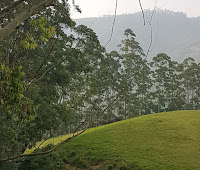
Worry I need not have, for the occupants of a charmingly rustic wattle and daub house B’Leaf Inn, sitting upon a hillslope, welcomed us with open arms. Proprietors Shah and Razook show guests exactly what it is like to live in this peaceful, remote part of the world. Multi-coloured vegetable fields of fennel, strawberries, cabbages, tomatoes, potatoes, garlic, fruit of every description, sit on terraced slopes and valleys; patches of forests hold eucalyptus and conifers.
Chef and owner of the land is Murthi, who uses as much of the ingredients grown on site as is possible while creating local dishes such as dinner that night, naadan chicken curry with coconut milk, chillis and spices, served with chapattis and salad.
B'Leaf Inn
After some tulsi tea (Ocimum tenuiflorum, commonly known as holy basil, which has therapeutic properties) it was time for bed. There are three en suite double bedrooms each with a shower and a western loo, a jute carpet, woollen blanket and pillows. We didn’t know to bring our own sheets or sleeping bags but I did bring the loo paper. Because it was so cold we slept wearing all of our clothing, and the three of us spent it in one double bed (there had been a hiccup with the booking system). I had a surprisingly good sleep (don’t know about the others!)

Morning walk
Chef & owner Murthi

In the morning it was chilly as we strolled to a waterfall, passed a dam and through forests. We met a local farmer cultivating cauliflowers, garlic, potatoes, carrots and beans. Via Achu’s interpretation we heard that he inherited the land from his parents who had died young. He came from the bordering state of Tamil Nadu. He said that from time to time wild elephants, tigers and wolves passed through right where we were walking. Once he came across a pack of wolves near the road, so all the villagers came with fire torches to scare the wolves away.

Breakfast at B’Leaf Inn 
was an amazing creation of puttu, steamed rice flour layered in coconut and pushed into a long cylindrical stainless steel vessel. Accompanying this was spicy kadala curry with black chickpeas, plus there was a fresh fruit salad, all laid out on the main verandah.
Walking back the two kilometres to the village we met stunningly beautiful neat and well-groomed young women carrying goods on their heads on their way to the fields. To witness daily uncomplicated life was such a privilege. 
Hubre popped into the local school and they welcomed us all with great beaming smiles.


Hubre meets the school children


Kumarakom

Coconut Creek homestay
We said goodbye to our travel organisers and with Mr Baby went through Munnar again (this is why a map is useful) and on to Kumarakom some seven hours’ away. It was a long drive...... 
Halfway there we stopped at a roadside restaurant for masala dosa (long very thin and fat crispy rice pancakes with fillings of potato, mustard seeds, onion, ginger, garlic etc served with chutney and a lentil-based vegetable stew). 
We also stopped at a supermarket to find tonic and lime…..
The roads were busy but moving, mostly single lane traffic. We passed mosques and temples and hundreds of churches, some crammed to overflowing with worshippers. 
It was a joy to reach Coconut Creek homestay just before nightfall, where host Ullas Babu (or his representative, not too sure who was who) greeted all. Communication wasn’t great but we gathered we were welcome to have a complementary vegetarian curry dinner with chapattis that night – perfect, after some pre-dinner gins and tonics. Here we each had an en suite private room, where a quiet fan lulled us to sleep and shooed away the mosquitoes.

The backwaters
From across a canal at the end of the homestay the soft melodious peal of church bells woke me around 0600, a comforting sound I had not heard since I lived in Ardingly, West Sussex some 16 years ago. Gentle warm rain pattered down as we sat for breakfast of omelette, rice pancakes in coconut milk, toast and jam.
In the dripping rain we took a Village Life Experience operated by Kerala Responsible Tourism, which embraces community-based tourism. Guide Sabu, previously of the Indian army, loaned us hat umbrellas that grip onto the head as we boarded a rickety traditional canoe and slipped into the canal water. Parting the clumps of invasive but pretty pinky-purple flowered water hyacinth (Kariba weed) we felt more in tune with nature on our rocky canoe than I’m sure those in the motorised boats that occasionally puttered by did.


White-throated and common kingfisher, Indian pond heron, black ibis, palm swift, brown kite, whiskered tern, Indian roller, blue tailed bee-eater, cormorant, black drongo,you name it, Sabu knew it so Hubre didn’t have to haul out the Indian bird book she bought in Cochin.

As Sabu slowly paddled everyday village life unfolded on the banks– it’s where everyone scrubs themselves, swims, where women wash pots and men fish. 
On dry land, a woman holds a clump of coconut fibre that has been soaked for six months in water then extracted from the shell. She makes coir rope using a basic but brilliant mechanism tied up to a tree; motorised hooks twist the tufted coconut fibre pulled from inside a coconut into long threads. An agile farmer scampered up a coconut tree to extract toddy from the leaf. We certainly didn’t scamper, but tried to climb a coconut tree using a device that felt like cumbersome leg callipers; we watched a woman make mats by weaving coconut leaves together; and saw how to make foamy hair 
 

shampoo by crushing hibiscus leaves just plucked from the hedge. We examined rice and tapioca plants growing in the ground, tamarind and cinnamon trees, unusual spiky looking plants, herbs and more.
Hubre lost count of the number of single shoes she had seen abandoned in just about every place visited. Was it due to the floods? Are shoes cheap in India? Nobody had an answer.


Three hours later we were at Alleppey (Alappuzha) on the top deck of a houseboat, looking across the famous backwaters of Vembanad Lake and wondering what on earth had hit us.
Gokul Cruise’s luxurious floating palace had a four-poster bed, jacuzzi in the bathroom, upper deck with sun loungers and sofas and three unobtrusive staff dedicated to just ourselves. Manager Muthus (also a bird expert) ran a tight ship, while captain Sanish steered and Justin cooked delicious traditional food like sadhya - various vegetarian dishes served on a banana leaf.
“I do not envy anyone today, except me,said Janee.
Good to learn that waste matter is not discharged into the lake but stored in bio-tanks on the boat where it is treated and then
emptied once back on shore. There’s surprisingly little litter considering the number of houseboats and rice barges that come here.
Sadya
And it didn’t matter that it rained the whole afternoon, in fact poured at one stage; when it’s warm rain it’s wonderful. The cyclone we were in the thick of caused our captain to change the plan as to where to moor overnight. Considering we had no idea where we actually were in this maze of lagoons, lakes and canals, it made no difference to us.

Back to Alleppey
Dawn was a rosy sky dotted with black ibis flying above the coconut palm-fringed shore. The rain had gone. Bird chirrups and faint singing from one of the pink Catholic churches way off in the distance wafted across the water. Slowly our houseboat sailed back to Alleppey, past islands peppered with coconut trees and little houses behind which green paddy fields stretched out, past serene women washing clothes, past feeder canoes anxious to give us a ride.  
We were sad to say goodbye to the backwaters.
Mr Baby drove us to a Hindu temple where we felt as if we were intruders so didn’t linger long. 
Another temple stop was the Mannarasala Sree Nagaraja Temple, a shrine dedicated to the Serpent God Nagaraja. Devotees believe the serpents have miraculous powers.

Here Srijith joined us again, arriving a few hours later than expected because of a state-wide dawn to dusk strike that also affected public transport. As we drove towards Mararikulam we met a large band of locals in the road protesting about the government’s decision to lift an age-old ban on women of menstruating age (10 to 50) from entering the Sabarimala temple in another part of Kerala, one of the holiest Hindu sites. It was a peaceful demonstration but hard for us to fathom why they should have been banned in the first place.
We then had a lovely chat and lunch at the very comfortable home of Srijith’s mother, who later took us on a short walk to her favourite place, the Mararikulam Sree Mahadeva Temple.
Xandari Pearl swimming pool area
Mararikulam

Then on to the beach to a spacious, secluded white bungalow at the Xandari Pearl resort in Mararikulam. It had a small garden, hammock under a coconut tree (with nets atop to catch falling fruit) and an outside bathroom. How magical it was to be looking at the moon and being totally surrounded by nature when taking a shower. Simply gorgeous! 
Our bungalow was five minutes’ walk from the sea with strong waves that pounded onto the shore.
                                                                                                                                                                                                  
Shower open to the elements
Reception


In the morning from the open bathroom, choral singing wafted over the bungalow’s wall from three different directions. It was Sunday after all. 
We returned to Cochin, passing paddy fields, colourful boats, more churches, tree-lined roads then checked into our hotel opposite Cochin harbour. 
Colonial charm
It’s like entering a history book when you get to the Brunton Boatyard with its lofty ceiling, punkhas and elegant teak furniture in the reception area reminiscent of the days of the Raj.  Re-built about 10 years ago from the remnants of a 19th century shipbuilding yard when the pepper trade was at its peak, the hotel retains its colonial charm while offering modern facilities. English, Portuguese and Dutch influences are reflected in the hotel’s décor and architecture, including huge portraits of dominant figures in Cochin’s history adorning the walls.

 Sanjeev K.R. & son

Local guide Sanjeev K.R. with his young son took us on a tour of Cochin, once an important trading post with its commanding position at the mouth of the Periyar River. 
Starting at the market in Jew Town, we visited 16th-century Paradesi Synagogue, a small Kappiri Muthappan shrine dedicated to African slaves brought in by the Portuguese, then St. Francis Church where Vasco da Gama was first buried (his remains are in Lisbon now) and which has particularly long punkahs cooling the congregation in the pews. 
Rain trees (Mimosaceae family) with their umbrella-like canopy of evergreen, feathery foliage and puffs of pink flowers, trunks festooned with ferns and moss, kept the avenues relatively shady. 

It was hard to leave the Brunton Boatyard’s elegant bedroom with a fabulous view of the port but leave we had to, and early the next morning, complete with breakfast of fruit and chicken sandwiches all neatly packaged in recycled bags made of newspaper, we left ‘God’s Own Country’ for the airport.

Our room with a view
Recycled breakfast bag


Wednesday, 21 November 2018

Zimbabwe with a step-ma

Joan and I waiting for an oven specialist
Last month: I’m in Harare where there’s a fuel shortage, the economy is in an uproar and people are stock piling whatever they can get their hands on. My main mission is to drive to the Eastern Highlands some 286kms from the capital to clear the remaining bits and pieces from my father’s house. I anticipate encountering all sorts of difficulties; my travelling companion is my partially sighted 85-year-old step-mother who wants to visit her old stamping grounds. Yet there is no real trouble. My way is smoothed by the hospitable, generous and ever-optimistic Zimbabwean people who, despite having enormous hardships, collectively make my 11-day stay easy, interesting - and also rather bizarre.

There’s always a bit of apprehension about heading back to Zimbabwe after a two-year absence as one never knows what to expect. Are there huge changes since Emmerson Mnangagwa took over? Is cholera rampant? Plenty of time to ponder on the transfer bus as it rumbles along Dubai International Airport’s tarmac towards the Emirates Airline plane destined for Harare, always parked at a slot miles away from anywhere.
On board, the movie Mary Shelley (author of Frankenstein aka Mary Wollstonecraft); directed by Haifaa-al-Mansour is compelling, a shocking true reflection of the loneliness and pain humans can cause to one another, yet again such pain can lead to inspiration as it did for her.
After the normal one-hour wait in Lusaka we depart for Harare International Airport, a quick 40 minute flight, then it’s US$55 for a single entry visa. Five purple bags trundle by on the baggage carousel and I haul off four mistakenly thinking one is mine. It then shudders to halt as a power cut darkens the room. This is one of the country’s many shortcomings. A generator eventually starts up and soon enough the bag arrives intact.
I’m met by a relative who expostulates about the economy, first trussing up the big purple case in the back of his pick-up truck as a precaution should an opportunist thief decide to pounce if we stop at the traffic lights. I wedge a smaller case underneath my feet so my knees are up to my chin.

It’s hard to fathom Zimbabwe’s money situation. Although the US dollar is the official currency, there’s very little hard cash in circulation so virtual banking and telephonic transfers are the way to pay for goods. US$ in cash are effectively twice or more (up to 6 times more) as strong as the virtual US dollar foreign currency residents hold in their bank accounts. This virtual money is also available in tangible notes and coins, known as bonds.

As I don’t have virtual/ethereal money I’m given a local debit card with access to this virtual money (held in a virtual bank?) plus a phone which also has virtual money on it, called eco-cash. And this is how all Zimbabweans pay for commodities.

Jacarandas in Marondera
[In 2008 the Mugabe government destroyed the economy with crippling inflation. As a result all pensions and savings held within the country were wiped out overnight. In February 2009 the US dollar became the official currency; from then on all deposits placed into local bank accounts were supposed to be US dollar deposits, put in by means of a mobile bank money transfer, a Real Time Gross Settlement (RTGS) transfer or cash.]


Living in a parallel universe surely forces people to be hugely inventive, flexible and sharp in order to navigate the laws that seem to change daily. Running any sort of business here is extremely challenging.
Once I get a grip on how to get around, an ex-farmer chucked off his property by Mugabe’s henchmen in around 2005 lends me his “pension”, a top-notch Toyota pick-up 1 ½ cab with GPS, air conditioning and ¾ full of diesel. He explains more about the economy but it is beyond comprehension. It seems to me the government is stealing from the entire population yet again.  Not surprisingly he heads for the Mozambique coast for a break.
 I head for Marondera about an hour’s drive from Harare where my step-mother stays with family. In this small town there’s a spectacular welcome from an avenue of jacaranda trees, their blossom creating purple carpets along the road sides. I’m told all’s well with family members but they have a few issues including a broken oven. Despite having taken it to a repair shop, there it has sat idle for six weeks because these specialists don’t have transport to move it to Mutare where repairs are done.
So when step-ma and I leave 8˚C Marondera next morning there’s an oven in the back of the top-notch pick up. Our suitcases are jammed against the back to stop the oven from crashing into the back windows should I have to brake suddenly.
The main road has a few toll gates manned by people who chat and laugh with us. It is refreshing to note that everyone here is very respectful towards my snowy white haired step-mother. She becomes almost a celebrity.
There is no fuel queue in Macheke where a happy attendant bounces out, fills up, asks me for a job as he knows I have just come from the big smoke of Harare, and I say, “You are better off here”. 

"Frankly my dear, I couldn't give a damn" 
In central Mutare an oven specialist called Milton meets us and jumps into the back of the top-notch pick up, directing us to Sakubva high density suburb where crowds are buying, selling, bartering and hanging out. Milton asks what’s wrong with the oven. “Haven’t a clue,” I say feeling rather stupid. Later on I discover the felt lining has been eaten by rats.
At a garage we have a pit stop and buy a loaf of bread for $1.10. I give a $2 bond note; the change is in tiny plastic bond 20 cent coins.
My step-ma, who smokes tobacco like a trooper when she gets a chance, puffs away. “Supporting the Zimbabwean economy,” she breezes and doesn't listen to those who tell her smoking is bad for her. Tobacco is indeed a big earner here.

Vumba


We reach the Vumba, a region of stunning mountain views, forests, streams and prolific birdlife including the rare Swynnerton's robin, sunbirds and silvery-cheeked hornbills. Despite her macular degeneration my step-mother appreciates the lush greenery and breathes in the absolute peace and quiet. Our hired stone cottage is just up the road from my house. It is modestly furnished with a cosy indoor fireplace that Jonathan the security guard comes to prepare, greeting us with a cheerful smile and perfect English.
Top Cottage Vumba
That evening our former housekeeper tracks us down in the cottage. Word gets around pretty fast here. Sipiwe was let go a month ago as new tenants are taking over the house with their own staff. But she helps me for the next three days and is the recipient of most of the paraphernalia we have been hanging onto (my father died in 2007) for whatever reason people hang onto stuff for. For daft reasons I take home a cut glass water jug, my parents’ Mah Jong set and one of my very first LP records - John Denver's Greatest Hits (1973).
Sipiwe with the piles of rubbish

I’m pretty glad Sipiwe is there as apart from the house being kind of remote she knows where everything is, and then there’s a scratching noise in one of the boxes of kitchen utensils. It sounds like an elephant but is in fact a large pregnant mouse, she tells me after dealing with it somewhere outside.
So we clear the house, my step-ma doing what she can sifting through old bits of paper, books, spectacles and shoes, rubbish left behind by some gold prospectors who once lived in the pool house but just disappeared in 2015 and haven’t been heard of since. We find an intriguing note: Moz. Go through Sussundenga to Dombe. Before Dombe on RT Chimanimani National Park – gold there. Dombe, Buzi River joined by Haroni and Rusitu rivers. Try to get to these. Haroni in Zimbabwe is mined by Russians for diamonds.”

From the house the views of distant hills and neighbouring Mozambique remain spectacular. Lion Rock mountain at the back is pink at sunset, golden in the late afternoon and often shrouded in mist.
On the second evening we have a stiff gin and tonic followed by a magnificent roast chicken and the best crunchy Yorkshire pudding ever (sorry Jackie Fulton from Richmond, North Yorkshire), provided at the cottage owners’ home. The Morgans have been here since the 1970s, seen many changes and despite times being tough don’t want to go anywhere, least of all their native Yorkshire. “Here I’m somebody able to make a difference, there I’m nobody,” Roger says. And they do make a big contribution to all in this tiny community.
Lunch next day is at nearby Whitehorse Inn, still serving up delicious meals and maintaining its lush gardens of elephant ears, shrubs, trees and lawn, and tucked behind the greenery is a sparkling blue swimming pool.

Whitehorse Inn pool
On Monday when we visit my lawyer in Mutare town we hear that the illegal money changers below their window are being handcuffed and marched off. I couldn’t see anything, only the tail of my top-notch pick up, a blessing that it is still there and still intact. It’s a bit of a worry driving around in someone’s pension.
The money changers set up business on the pavement using deckchairs as offices, do deals via mobile phones, while cash is carried in sling bags across their chests. Most people use these dealers so are a bit sad at their arrest.

We then visit a friend of a friend who is up in arms about the potential development of 67 houses in an area clearly marked for agricultural use. The Mutare District Council could have a battle on its hands - but I sadly doubt it. There’s a magnificent lunch of fresh garden produce and steak  and kidney pies. Another lunch guest goes to a great deal of trouble to bring me a very special chunk of wood - generally used for making wind instruments – which my son has asked me to source for him to make a knife handle at his self-built forge.
On the way back to the cottage we stop at a garage to pick up a coke. At the check-out the cashier tells me I cannot have it. When I look surprised, she says:  “No takeaways, unless you have an empty glass bottle - do you?” I didn’t. And back at “home” there is Jonathan waiting to make the fire and chat about life in the district. Nancy also comes by, hugging her jumper to keep out the cold wind, and offers me some delicious home-made vegetable soup as I have now developed an Asian cold (it must have come off the plane).

La Rochelle Estate

La Rochelle Country House

Next day we take ages to depart as we don’t really feel like leaving this beautiful part of the world, but head to La Rochelle Estate off the Penhalonga Road. The French-style turreted country house built by Sir Stephen and Lady Virginia Courtauld in 1951 and donated to the National Trust of Zimbabwe (NTZ) in 1970 has been beautifully revamped. There are rose and botanical gardens, an orchid house and an agricultural training centre for small scale farmers.

The philanthropists whose wealth was based on textiles fascinate me as Sir Stephen had been awarded the Military Cross for his bravery in the First World War while Lady Virginia was the daughter of an Italian marquis, a divorcee, had a snake tattooed up her leg (rather a shock to society in 1930s’ Britain) and travelled around the world with a pet ring-tailed lemur called Mah-Jongg. He is buried in the garden - a granite monument featuring a carved lemur on the front has the rather poignant words: “Companion in our travels over many lands and seas” engraved on one side, and “Much loved member of our family for fifteen years” on the other. While eccentric they did a lot of good deeds for the country and its people, and built many public structures which are still in use today.
A lemur's tombstone

In the orchid house Peter shows me the rare Vanda lombakensis Virginia Courtauld, discovered on an East Java island and so named by Sir Stephen Courtauld. It was kept in a glass house in their property at Eltham Palace, London. When this was bombed in the Second World War, a tiny piece of the orchid was salvaged then brought to Southern Rhodesia when they moved here. In 2016 it flowered for the first time after 40 years. Peter hopes it will flower again in February 2019.

We return to Marondera. That night a bush baby (or nagapie in Afrikaans – it’s a small primate), establishes itself the jacaranda tree outside our house and screeches loudly at the domestic cats below. Ah Africa! I successfully eco-cash money to Sipiwe who now has a job in the Chimanimani. I’m getting the hang of things.
Tabitha at the avocado tree

I leave my step-mother behind as there is no fuel in Harare so we have no idea of how or when she could get back. I also suspect she is succumbing to my Asian flu. Feeling a complete heel I depart, along with six enormous avocados just picked off their trees.


Ngomokurira


There’s a small boy at Mutake Primary School in the village of Ngomokurira who has Steven Johnson Syndrome, apparently a reaction to an antiretroviral drug. I WhatsApp his doctor to ask what is needed as I’m visiting the school today. A prescription arrives by email and I can only get it if I pay in US$ cash at a particular pharmacy in Harare. For a visitor it is not an issue to hand over the rare foreign currency. Three tiny bottles to briefly alleviate his painful and itchy eyes cost $48.
In the top-notch vehicle I fetch an ace botanist relative who knows the way to Domboshawa and the Ngomokurira hill. Head teacher Mrs Nyamuhwe tells us there are 1,128 kids, 20 teachers and 12 student teachers, so it is about 40 to 45 children in a class. We are taken aback at how well-disciplined, attentive and polite the children are. The parents and teachers run the school while the government pays for the teachers’ salaries. There are not enough classrooms so half the lessons are conducted outside under shady mango trees. The tiny open-sided block of a kitchen is closed due to the cholera outbreak in another part of Harare earlier in the year.

The kids’ uniforms are a crisp, white-and-green check and every child has one. Most have shoes, but not all. They have rabbits in hutches and a vegetable garden for the children to nurture, harvest and then sell in the local market to swell school funds. Some parents are installing beehives in the eucalyptus trees, the honey from which will also be sold.

Inside class
Outside class


In the bare earth playground that holds two metal slides, a see-saw and old car tyres half buried in the ground, the children seem happy.
Before we leave the head and deputy head insist we have some food, it is the Shona custom. We feel greedy about taking the grilled chicken from them as they have so little, but of course do so.


Bougainvillea


Back in Harare the next day I have breakfast with retired family friends who travel a great deal but spend more and more time enjoying Zimbabwe’s climate, social life and golf courses. Their main concern today is a crumbled pergola festooned with bougainvillea which is now being propped up by some old planks. A man arrives to talk about reconstructing it. My friend was quoted $900 for the job last Saturday; by today Friday it will cost him $6,000 for the same thing. Of course my friend explodes and there’s a bit of argie bargie with the owner of the company down the telephone line and the poor bearer of bad news gets it in the neck. My friend will not bend the knee to people who climb on the band wagon of this economic crisis, so the bougainvillea will continue to be propped up by old planks.
I spend the weekend with other friends, and we chew the fat on the patio enjoying the cool evening air and a little Bombay Sapphire and tonic to keep away the mosquitoes (none at this time of year but it’s a great excuse).
The white stripes in the centre are firemen

Around 7.30pm one night we see a ball of orange fire consume a tree in what looks like the next door garden. Being alarmed as well as innately curious I go to investigate and discover it is on the boundary of the neighbour and its adjoining property. Three by-standers hover at the gate, saying there are big dogs inside. I whistle and yell and eventually a thin dishevelled old man scrambles to the gate and beckons us in frantically. He had been burning rubbish (illegal in a residential area) and torched two enormous tall trees in the process. Other people including a security guard, a tipsy chap, two young men constantly pressing their mobile phones and a caretaker from the Franciscan Friars Centre also come to look or help.

Not one person along that road has a complete hosepipe, just bits. Together we try to make a hosepipe out of the pieces, finally get one long enough, and apply it to the tap. The water trickles out - the pressure is useless for a blaze that high. We try throwing buckets of water from a fish pond at the flames but really it’s no use.
No-one has called the fire brigade as they don’t have faith in a system that didn’t work in Mugabe’s era. No-one knows the correct number - when I Google 111 comes up but no answers from that. (I discover later that’s New Zealand’s emergency number.)
Eventually my friends find a number which I call. Surprisingly a man answers instantly, asks relevant questions, and says: “We are coming”. Yeah right we say and look at the sparking orange trees opposite us with trepidation. But sure enough, within 10 minutes a fire engine is zooming down our road with lights blazing and siren whooping. Strong pressure hoses pound the fire and later we hear the still sparking trees being cut down with a chain saw.


Visit


I’m trying to convey that while it is not a destination on many people’s radars, (although Lonely Planet has just added it to their list of 10 destinations travellers should visit in 2019, see https://www.lonelyplanet.com/best-in-travel/countries), visitors here will learn some life lessons and also may appreciate that special sense of community that exists in some parts of Africa. Zimbabwe is conundrum, a mixed-bag of highs and lows, of things that work and things that don’t.  Real dollars will boost morale and help the nation rebuild, while the visitor will get more than just a bog standard holiday. The country offers unparalleled natural beauty, historic treasures and national parks with professional guides cited among Africa’s best.
Support of the tourism industry filters down to the people of country, 90% of whom are unemployed (albeit become small-scale entrepreneurs by default). That’s just what Zimbabweans do – they make a plan.


NEXT MONTH: KERALA, GOD’s OWN COUNTRY!

Tuesday, 17 January 2017

0-14 Tower (aka Swiss cheese building)

0-14  tower - photo by Cheryl
Dubai’s architectural smorgasbord of skyscrapers may be dominated by the Burj Khalifa, the Princess Tower and the twisted Cayan Tower, but a comparatively short structure in Business Bay is also a remarkable feat of engineering.
The 22-storey 0-14 tower locally nicknamed the ‘Swiss cheese building’ makes its mark on the city with a holey, curvaceous, poured concrete exoskeleton that supports a main enclosure within.
Architects Jesse Reiser and Nanako Umemoto of RUR Architecture, New York, created the 40 cms thick outer shell of white concrete perforated with 1,326 different sized holes - giving it the appearance of a chunk of Emmental cheese - in a startling departure from the standard glass-clad box high rise.
The unique design of this 105.7-metre commercial tower on the extension of Dubai Creek has won many awards for the architects, and of particular significance is that five years after its completion the tower has matured well, just like a good cheese.
Says Reiser, “As compared to a typical aluminium glass curtain-wall tower, which begins to deteriorate visually in the extreme climate of Dubai, the desert gives the shell a patina that only improves the appearance of the building as it ages.” 
When Business Bay was first opened to development the brief from Creekside Development Company was simple: make the buildings different.
“It was one of the few radical projects that was proposed towards the end of the economic boom and successfully completed [in 2010], despite the economic downturn,” says Resier, whose only problem was how to build a stunning structure that wasn’t going to be like any other. Inspired by Islamic architecture, he noticed the effect of the jali, the latticed screen that moderates the amount of sunlight entering a space. While decorative, says Reiser, it is also functional for it shades a building from the heat of the sun.

About one metre away from the exoskeleton is an inner glass wall enclosure following its contours. The two are linked by structural concrete tongues, so allowing column-free open spaces in the building’s interior, where there’s a central stair and elevator core.
“The one-metre space between the façade and the building's glass surface creates a chimney effect causing hot air to rise, creating an efficient passive cooling system, therefore reducing the energy consumption by approximately 30 per cent,” says Vasileios Vatistas, Property Manager, H&H Property Management.
The architects found this project unique in many respects, including having close relationships with developer H&H Investment and Development, Erga Progress Engineering Consultants (ERGA) and contractor DCC Construction. “This was not a typical corporate project, it was very personal, and the work among the team members was very direct and we were all basically on the same page,” he says.
Named 0-14 after the Business Bay site number, the lace-like tower perched on a two-storey podium officially opened to the public in 2011.
Jesse Reiser & Nanako Umemoto
“Undoubtedly the O-14 tower has made its impact in the Business Bay area as an iconic landmark,” says Vatistas, adding that features include a-state-of-the-art hydraulic car park system, around the clock security services and amenities such as a ground floor café, 10,000 square foot of external terrace space, prayer rooms and four basement levels that hold up to 416 parking spaces and storage areas.
Awards for 0-14 include an Architecture Honour Award in the American Institute of Architects New York 2013 Annual Design Awards, the Concrete Industry Board’s 2009 Award of Merit, the American Council of Engineering Companies’ 2009 Diamond Award, a silver Emporis Skyscraper Award in 2009, an ACEC National Honour Award for Excellence in Engineering Design in 2010, and it was a finalist in the Best Tall Building in the Middle East and Africa 2010 Council on Tall Buildings and Urban Habitat awards programme.

This is an engineering masterpiece that matures with age.

Wednesday, 1 June 2016

Mountain biking in Zimbabwe

ZCC Victoria Falls region
Pumping Legs for Water Hwange

Unless you have nerves of steel, waiting for an elephant to move off a path it has followed for centuries (the same one that you are sharing perched on a bike) could be a little scary. But in a region where man is the intruder, meeting wildlife along the designated routes that course through game paths, single tracks, grasslands or sandy roads gets the adrenaline going just as much as the tricky terrain and stunning natural beauty.
In southern Africa three annual epic biking challenges beckon. 
One takes you through Zimbabwe’s biggest game reserve, another skirts the Victoria Falls waterfall, and there’s also an expedition that traverses three countries.
Tour de Tuli (TdT)
Any four-day five-night multi-stage challenge tackling 300 kilometres of rough terrain in a remote corner of Africa is going to spell adventure. It usually happens in July /August in the Tuli Block of private safari land connecting Botswana, Zimbabwe and South Africa.
Supported by the governments of all three countries, this mountain bike safari takes in bush paths, sandstone cliffs, single track of scree, fever trees, thorny bushes, impromptu encounters with animals and makeshift river border crossings. There’s some serious single track riding topped only by an incredible spirit of comradery.
On July 28 in 2016, riders had to get to the Pont Drift border post between South Africa and Botswana. Armed with passports, they then rode 2.8kms from the border to the first night’s camp at the Limpopo Valley Airfield in Botswana.
The next day at sunrise riders set off towards the Majale River and where the vegetation thickens and where elephants could have been hiding in the shrubbery. Beyond Hammerkop Crossing are ancient elephant tracks carved into sandstone ridges. Brunch was served at Pride Rock on the banks of "the great grey-green, greasy Limpopo River", as author Rudyard Kipling describes in his Just So Stories.
The course ploughed on through three kilometres of sand, acacia thickets, donkey tracks and subsistence farm lands. The 4th day of hard riding ended on 1 August at the baobab-sprinkled Mapungubwe National Park in South Africa, where there was a big party under the stars.
The TdT is a strenuous challenge requiring preparation, some technical skills and an ability to cope with the heat.
Never a dull moment in Africa
Routes and camps are different every year, but it usually amounts to 60 to 80 kilometres of cycling per day. The minimum sponsorship donation was US$1,610 per person (2016). Proceeds go to Children in the Wilderness (CITW), a Wilderness Safaris initiative set up to facilitate sustainable conservation through leadership development and education of rural children in Africa.
Participants (maximum 350) can hire mountain bikes from the organisers but it’s simple enough to box up your own bike and bring it as luggage.
Zambezi Cycle Challenge (ZCC)
The ZCC meanders around the Victoria Falls, the largest sheet of falling water in the world. It drops for 108 metres and stretches 1,708 metres across the Zambezi River, which forms the border between Zimbabwe and Zambia.
 It’s not hard to understand why locals call this waterfall Mosi-oa-Tunya (the smoke that thunders), for at certain times of the year the water pounding onto the rocks below creates a spray that billows upwards just like smoke.
This three-day stage event starts on 8 July and runs through 150 kilometres of varied terrain that includes marshland, single track on cliff edges, teak forests and grasslands peppered with wildlife.
Victoria Falls residents Bruno De Leo and Brent Dacomb established the ride in 2015 to raise funds for CITW and the Victoria Falls Wildlife Trust (VFWT), a local wildlife and environmental conservation organisation.
Each day riders start from and return to the Elephant Hills Hotel, which serves as a cycle village and central hub for logistics and briefings for each day’s ride.
Day one starts with a 0600 transfer to a spot 40kms south of Victoria Falls along the Bulawayo Road. Initially there is 75 kms of gravel road then the course bumps along old hunting tracks and elephant paths. Cross the Matetsi River first then double track appears for about 20 kms, after which riders go into single track through wildlife areas and community reserves until they hit tar and civilisation as we know it.
The following day cyclists are dropped off early on the road to Kazungula, from where they head into the marshy grasslands of Westwood Vlei, along often barely visible tracks. Last year De Leo came upon a hyaena den with two sets of pups here. “Totally relaxed, they played and suckled as we quietly enjoyed the sighting,” he said.
The route heads through the Matetsi private concession down to the Zambezi River, where it snakes alongside the water’s edge, sometimes looping off inland on a combination of gravel, single and double track all the way back to Elephant Hills Hotel.
Day three is about riding on the edge, a technically challenging 45 kilometres stretch of 90 percent single track leading along the spectacular Batoka Gorge.
Families and competitive cyclists can take part, but prior training of at least one off-road cycling event of 70kms and two long rides of more than five hours each is expected. Entry fee is US$325 per person, and further donations welcomed.
Pumping Legs for Water (PLFW)
This annual 100 kilometre mountain bike ride raises funds to help wildlife survive the dry season in Hwange National Park, Zimbabwe’s largest game reserve.
TdT
Covering more than 14,000 square kilometres, the park relies heavily on pumped water that is extracted from underground sources and fed into surface pans. The money raised each year is administered by Wildlife Environment Zimbabwe (WEZ) and is used to develop water sources, buy fuel for the pumps and to maintain engines, boreholes and drinking troughs.
The PLFW ride takes place on July 22 and 23 around Main Camp, a self-catering accommodation hub within the park. It is aimed at all levels of riders (no children under 10 years old) although participants should have had some off-road training.
Cyclists are seeded according to their ability or in families wanting to ride together. Groups are escorted by a lead vehicle carrying an armed National Parks game scout, followed by a sweeper truck which stays with the group throughout. To ride in a game reserve means some serious rules have to be observed, but the advantages are huge - you can get up close and personal to nature in safety.
Winter falls in July, meaning warm clear skies in the day and extremely cold temperatures at night. So it will be a chilly start on day one, when riders head out of Main Camp to the Ngweshla picnic site 55kms away. Back in 2013, a group of participants lining up at the starting point were momentarily delayed by a pack of African Wild Dogs (also known as Painted Dogs) pursuing a young kudu through the area. It was a little reminder for riders to expect the unexpected.
The flat gravel roads hold a few surprises including soft sand, rocks and corrugations. Ngweshla picnic site is in one of Hwange’s best game viewing areas with a small pan that attracts anything from secretary birds to predators. Finishing in the afternoon, riders are returned to Hwange Main Camp for the night and a talk by a researcher from Hwange.
 The route for day two is yet to be confirmed but will be another 45 to 55 kilometres. Closing date for entries is 27 June 2016. A few bikes are available for hire via the Ride Organising Committee. Those wanting an extra challenge could make their own way to Hwange Main Camp from Bulawayo Airport (450kms away) or from Victoria Falls (175kms away), just ensure you get there in time for the event briefing on the night of July 21.
The basic entry fee is US$150, additional sponsorship is entirely up to the individual and there’s a prize for the person who raises the most. Last year 108 cyclists took part and raised US$49,280.
(First published in Cyclist Magazine Middle East June 2016)

Friday, 14 June 2013

Swimming with sharks

The tawny nurse shark stared passively at me through one pale blue eye. Her sensory barbels tickled the cage I was snorkeling in while she searched for food. Surmising that she wouldn’t find it apart from between those bars she moved off to swim with others like her - blacktip, grey reef, bamboo, horned, zebra, swell and wobbegong plus 69 other marine species at the Dubai Aquarium and Underwater Zoo bang in the middle of Dubai Mall.
We climbed backwards into the four metre deep aluminium cage, finding a resident bunch of barramundi had already taken up a prime safe position away from predators, for transparent acrylic covers the bars on the two four metre-long sides and at the bottom. The cage holds four people at one time plus instructor and offers a fish-eye view of the fascinating underwater world from a completely safe vantage point.
A sand tiger shark slipped silently past on my left while a blotched fantail stingray cruised, slowly flapping its circular-shaped disc beneath my feet. Two unicorn fish with extraordinarily horn-like appendages between their eyes negotiated their way through an open side to brush my ankles, completely ignoring my excited yelps, somewhat muffled through a snorkel .
“Last year 791 people were killed by defective toasters,” states my guide Tata Jemray as we come up for air. And your point is? The point is that we are not food for sharks. Far less people have been killed by sharks than by toasters, yet sharks carry this stigma.
Sharks provide a natural balance but as many as 80 per cent of some shark species have been killed off by man, which is why some species are now protected by law from fining (cutting off the fins for soup and other products) and fishing.
Like a goldfish I watch spectators walk through the tunnel below, snapping away at the shoals goggling at them through the viewing panel which, according to Gordon White, General Manager of Dubai Aquarium and Underwater Zoo, holds the Guinness World Record for ‘the single largest acrylic panel’ at 32.88 metres long by 8.3 metres high.
As I climb out thinking how well worth the 40-minute, Dh290 experience is, a Napoleon Wrasse gives me a wink.

Flamingoes

Flamingoes at Ras Al Khor in Dubai 
Just off the Oud Metha Road around 9am and 4pm there is a rosy flush of excitement at Ras Al Khor Wildlife Sanctuary, a tidal estuary with saline lagoons at one end of the Dubai Creek. It's when the supplementary feed truck arrives.
Swathes of pale pink, flashes of deeper pink and white wings flap expectantly around the food handler. Some ungainly greater flamingoes taxi in from further afield. Once the feed hits the water a scrum of pink stick legs, bent in the opposite direction to that of a knee joint, support feathers and long necks that are plunged into the water, the upside-down beaks filtering it furiously and making gentle sucking, chewing and splashing noises. At peak times there are more than 3,000 here.
Black winged stilt
Once replete, calm descends upon the sanctuary again. Although the greater flamingoes (not the brighter pink lesser flamingoes) are the draw cards, some quiet time spent in the basic wooden hide, accessible from the car park via a screened jetty walkway, reveals just how many resident and wintering birds love these nutrient-rich mudflats.
Thousands of birds from Africa, Asia and Europe have used this area to rest and refuel while on their annual migration on the East Asia/ East Africa flyway, long before the sanctuary was established in 1985. Numbers have increased since it was officially declared a protected area in 1998 and now maintained by Dubai Municipality, which cites housing 270 species. About half the flamingoes and birds remain here in the hot summer months.

Tracking wildlife

Gazelle and tracks in the sand
There’s a primeval thrill in following animal tracks in the sand. Maybe it’s because we are supposed to be hunters and gatherers.
Pursue a trail of fresh heart-shaped spoor and the chances of finding an Arabian gazelle grazing at the other end are fairly high. Breathe in the cool morning air that gently brushes the skin awake and listen to the mesmerising stillness. We have forgotten what silence is.

Duane Eksteen is among the field guides at Al Maha Desert Resort and Spa who lead visitors into the Dubai Desert Conservation Reserve (DDCR) on nature walks. It is astounding just how much life is out there in the golden dunes. Even ants have footprints. Adapting to its environment is the desert runner ant, which folds itself in such a way as to avoid touching the baking sand beneath.
Desert runner ant
Eksteen points out the tracks of an Arabian gazelle and a spear-horned oryx. He can tell if a francolin or a bustard crossed the road earlier but to see a ‘sand-fish’ in the open - he rates as virtually impossible.
 “It’s like a golden lizard and walks above ground but as soon as it feels threatened it dives into the sand,” he says.All you see is a flick of swirling grains of sand as it burrows away from danger.
Untidy scuffles around a burrow indicates Leptien’s spiny-tailed lizard is either dozing below or has left the building. The DDCR introduced 70 Arabian oryx around 2004 and now houses close on 500. The vulnerable Macqueen’s bustard was also introduced here.
As we do the ghaf tree walk Eksteen seems impressed. “When the Bedouins travelled through the desert they would stop here, pitch their tents and start digging because these amazing drought resistant trees push their roots straight down 30 metres or so, to reach the ground water.”
The shady ghaf forest provides shelter for all creature, from oryx to lesser jerboa, and branches make ideal perches for about 126 visiting and resident bird species.
Under a fire-bush we spot a lone female gazelle resting in the shade. It’s warming up now and time to head back to the resort. And by the end of the day our tracks too will have shifted in the sand.

 Original article: